We offer a range of denture types at Berkhamsted Dental Practice. Your dentist will advise on the most appropriate option for your situation at your consultation, taking into account how many teeth you are missing, the condition of any remaining teeth, and your overall goals.
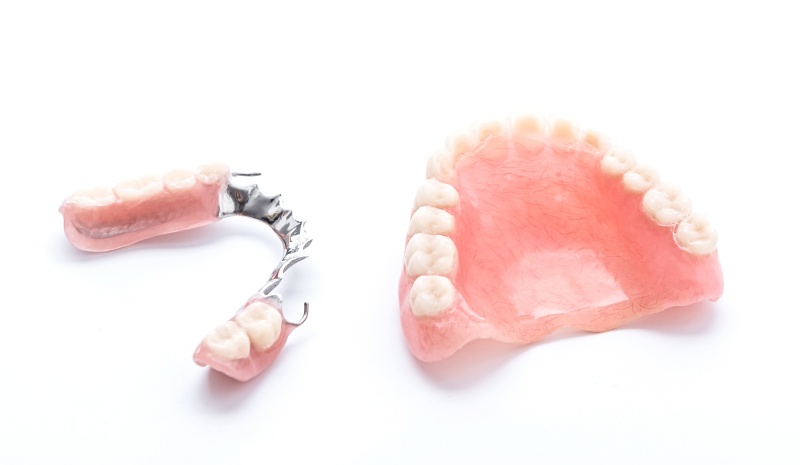
A full denture replaces all of the teeth in the upper or lower arch, or both. Modern complete dentures are crafted to match the natural proportions of your face and the shade of your remaining oral tissue, restoring a full, natural-looking smile that supports the lips and cheeks and maintains facial shape.
Suitable for: Patients who have lost all teeth in one or both arches.
A partial denture replaces one or more missing teeth where natural teeth remain. Carefully designed to clip or rest against the remaining teeth, a well-made partial denture is stable in use, comfortable to wear, and virtually undetectable in the smile. Partial dentures can be made from acrylic or from cobalt-chrome metal, which offers greater stability and a slimmer, more comfortable fit in many cases.
Suitable for: Patients who have lost some but not all teeth in an arch.
An implant-retained denture combines the stability of dental implants with the coverage of a full denture. Small implants are placed in the jaw to provide anchorage, eliminating the instability and movement that some patients experience with conventional full dentures. The result is a denture that fits securely, feels more natural, and gives patients considerably more confidence when eating and speaking.
Suitable for: Patients who want greater stability and security from their full denture.


Fees for denture treatments depend on the type of appliance, the complexity of the case, and the extent of treatment required.
In all cases, a full treatment plan and fee breakdown will be provided at your consultation before any work begins. There are no surprises, and no obligation after your initial appointment.

This depends on how many teeth you are missing. A partial denture replaces one or more missing teeth where natural teeth remain; a full (complete) denture replaces all teeth in the upper or lower arch.
At your consultation, your dentist will assess your mouth and discuss the most appropriate type of denture and whether alternatives such as dental implants or implant-retained dentures may be worth considering.
Yes. Modern dentures are crafted from lifelike materials and shade-matched carefully to complement your face shape, skin tone, and remaining oral tissue.
The goal is a result that looks completely natural, and that restores the fullness and symmetry of your smile. We trial the denture before it is finalised, so you can see exactly how it looks and feels before it is set.
Most patients adapt to a new denture within a few weeks. The first days can feel unfamiliar; speaking, eating, and the sensation of the denture in the mouth all take some getting used to.
Mild soreness at pressure points is common initially and is easily addressed with a simple adjustment appointment. With a well-made, well-fitting denture, most patients find they quickly forget it is there.
Some initial soreness or pressure points are common as a new denture beds in, and these are easily resolved with a brief adjustment appointment.
If you experience ongoing discomfort, please contact us rather than tolerating it: a denture that is causing soreness can usually be adjusted quickly and straightforwardly. Fit may also need to be revisited over time as the jaw changes naturally after tooth loss.
As the jawbone changes naturally after tooth loss, the fit of a denture may alter over time. This is normal, not a sign of poor craftsmanship.
A denture that has become loose or unstable can often be relined to restore a comfortable fit, or remade where needed. Your dentist will assess the fit of your denture at your regular check-ups and advise accordingly.
Dentures should be cleaned twice daily, either with a dedicated denture brush and cleaner, or a soft toothbrush and non-abrasive toothpaste. They should be removed overnight to allow the gum tissue to rest, and stored in water or a denture-soaking solution.
Regular cleaning prevents the build-up of bacteria and staining and helps the denture last as long as possible.
Yes. Even patients with no natural teeth should attend regular dental check-ups. Your dentist will examine the soft tissues of your mouth, check for any early signs of problems, and assess the fit of your denture. Oral health extends beyond the teeth, and ongoing care remains important.
A conventional denture relies on the gums and, in the case of partial dentures, the remaining teeth for support. An implant-retained denture is anchored by small titanium implants placed in the jawbone, which provides a significantly more stable and secure fit.
Patients who find conventional full dentures unstable, or who want greater confidence when eating and speaking, often find implant-retained dentures transformative. Your dentist will discuss whether this option is suitable for you at your consultation.





Whether you’re booking your first appointment, have a question about our treatments, or simply want advice on your dental care — our friendly team is here to help.